Thursday, 25 October 2018

What is the jarsigner tool?

The next tool we'll look at is the jarsigner tool; this tool creates signed JAR files. The jarsigner tool uses the information in a keystore to look up information about a particular entity and uses that information either to sign or to verify a JAR file. 

The keystore that jarsigner uses is subject to the KeyStore class that has been installed into the virtual machine; if you have your own keystore implementation, jarsigner will be able to use it. Similarly, if you use the standard keystore implementation, but hold the keys in a file other than the default .keystorefile, jarsigner will allow you to use that other file as well.

Here are some of the screenshots:


Wednesday, 24 October 2018

What is Eclipse Plugin?

Plugins are the smallest deployable and installable software components of Eclipse.
Each plugin can define extension-points which define possibilities for functionality contributions ( code and non-code ) by other plugins. Non-code functionality contributions are for example the provision of help content.
The basis for this architecture is the runtime environment Equinox of Eclipse which is the reference implementation of OSGI. See OSGi development - Tutorial for details.
The Plugin concept of Eclipse is the same as the bundle concept of OSGI. Generally speaking a OSGI bundle equals a Plugin and vice-versa.

Here are some of the screenshots:


http://www.vogella.com/tutorials/EclipsePlugin/article.html

What is Maven?

Maven is a "build management tool", it is for defining how your .java files get compiled to .class, packaged into .jar (or .war or .ear) files, (pre/post)processed with tools, managing your CLASSPATH, and all others sorts of tasks that are required to build your project. It is similar to Apache Ant or Gradle or Makefiles in C/C++, but it attempts to be completely self-contained in it that you shouldn't need any additional tools or scripts by incorporating other common tasks like downloading & installing necessary libraries etc.

It is also designed around the "build portability" theme, so that you don't get issues as having the same code with the same buildscript working on one computer but not on another one (this is a known issue, we have VMs of Windows 98 machines since we couldn't get some of our Delphi applications compiling anywhere else). Because of this, it is also the best way to work on a project between people who use different IDEs since IDE-generated Ant scripts are hard to import into other IDEs, but all IDEs nowadays understand and support Maven (IntelliJ, Eclipse, and NetBeans). Even if you don't end up liking Maven, it ends up being the point of reference for all other modern builds tools.

Here are some of the screenshots:


https://stackabuse.com/what-is-maven/

What is the HornetQ Messaging System?

HornetQ is an open source project to build a multi-protocol, embeddable, clustered messaging system with very high performance, .

Messaging systems (or MOM for Message-oriented middleware) are systems focused on sending and receiving messages to increase the interoperability, flexibility and the performance of applications. They decouple the producers of messages from the consumers. The producers and consumers of messages are completely independent and are not aware of each other spatially (they can run on different nodes) and temporally (they do not need to be running at the same time, the producers can send messages even if there is no consumers and vice versa). This allows to create systems more flexible and loosely coupled than using remote procedure calls (or RPC).

Messaging systems are often used to implement as message bus which loosely couples heterogeneous systems together. Using a message bus to decouple disparate systems allows the systems to grow independtly and adapt more easily. It provides more flexibility to add new systems or update existing ones since they don't have brittle tight-coupled dependencies on each other.

Here are some of the screenshots:


https://dzone.com/articles/hornetq-getting-started

What is ActiveMQ?

Apache ActiveMQ is a message broker which fully implements the Java Messaging Service API 1.1 and Supports a variety of Cross Language Clients and Protocols such as Java, C, C++, C#, Ruby, Perl, Python, PHP. This makes messages to share a common format and semantic, which makes integration between different applications easier.

We are looking into a JMS example, which involves two JMS clients. First client sends a message to a queue destination. The second client retrieves the message from the same queue destination.

It is used to reliably communicate between two distributed processes. Yes, you could store messages in a database to communicate between two processes, but, as soon as the message is received you'd have to delete the message. That means a row insert and delete for each message. When you try to scale that up communicating thousands of messages per second, databases tend to fall over.

Message oriented middle-ware like ActiveMQ on the other hand are build to handle those use cases. They assume that messages in a healthy system will be deleted very quickly and can do optimizations to avoid the overhead. It can also push messages to consumers instead of a consumer having to poll for new message by doing a SQL query. This further reduces the latency involved in processing new messages being sent into the system.

Here are some of the screenshots:


https://techaffinity.com/blog/java-message-service-jms-using-activemq/


Tuesday, 23 October 2018

What is hibernate framework?

Hibernate is a pure Java object-relational mapping (ORM) and persistence framework that allows you to map plain old Java objects to relational database tables.The main goal of hibernate is to relieve the developer from the common data persistence related tasks.It maps the objects in the java with the tables in the database very efficiently and also you can get maximum using its data query and retrieval facilities.Mainly by using Hibernate in your projects you can save incredible time and effort.

Persistent data can be seen anywhere in an application. Managing persistent data is one of the few challenges that modern technologies/products are facing. A solution called Object-Relational Mapping (ORM) has gained major popularity over the past few years. ORM is a piece of software/product for the representation and conversion of data between the database and the object-oriented programming language. Hibernate is one such ORM solution and it is an open-source project.

Though Hibernate Framework is not the only persistence solution, it has become very famous over the recent past because of its huge variety of features when compared with its competitors. It takes much of the database related boiler-plate code from the developers, thereby asking the developers to concentrate on the core business logic of the application and not with the error-prone SQL syntax.

Here are some of the screenshots:


https://javabeat.net/hibernate-ormobjectrelational-framework-an-introduction/

What is Apache Ant?

Ant is primarily used for building and deploying Java projects but can be used for every possible repetitive tasks, e.g. generating documentation.

A Java build process typically includes:

  • the compilation of the Java source code into Java bytecode
  • creation of the .jar file for the distribution of the code
  • creation of the Javadoc documentation

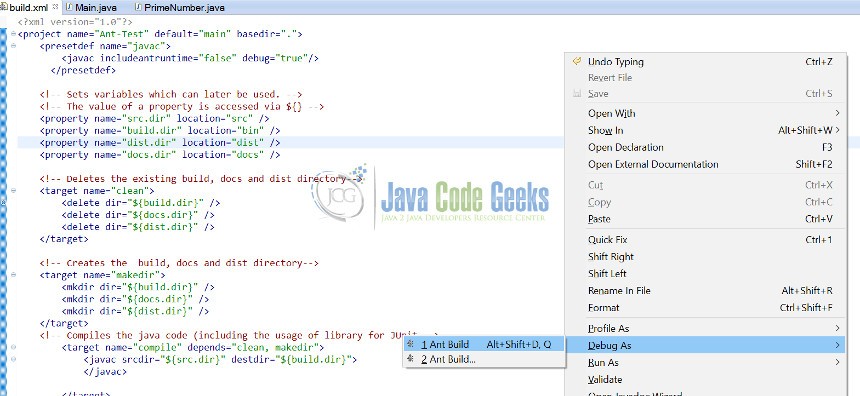
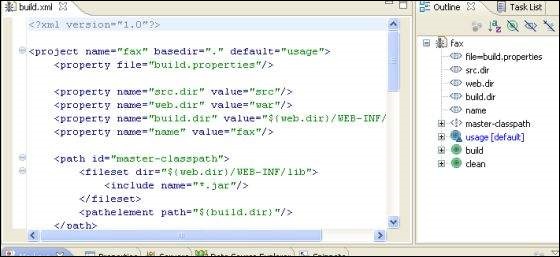
Ant uses an xml file for its configuration. The default file name is build.xml. Ant builds are based on three blocks: tasks, targets and extension points.

A task is a unit of work which should be performed and constitutes of small atomic steps, for example compile source code or create Javadoc. Tasks can be grouped into targets.

A target can be directly invoked via Ant. Targets can specify their dependencies. Ant will automatically execute all dependent targets.

Here are some of the screenshots:


http://www.vogella.com/tutorials/ApacheAnt/article.html